Is Medical Sales the Right Career Transition for You?
At some point in almost every career, people begin asking whether they are on the right path. You may be looking for more growth, a different industry, greater earning potential, a new challenge, or simply a career that better fits your strengths.
Medical sales can be an attractive career for professionals who enjoy selling, building relationships, learning complex products, and working in a healthcare environment. But a career transition should be made thoughtfully. Medical sales is not simply an easier version of another sales career, and knowing a medical product does not automatically make someone a successful salesperson.
Before making a move, take an honest look at what you have accomplished, what you want next, and how your experience translates to the position you are pursuing.
Your Existing Experience Matters
A career transition does not mean starting over. In many cases, you are bringing years of experience with you.
If you have been successful in outside sales, business development, account management, technical sales, healthcare, or another customer-facing role, identify the skills that can transfer. Prospecting, relationship building, territory management, presentations, negotiating, closing, account growth, and managing a sales process are valuable skills in many medical sales positions.
The important part is showing the hiring company how those skills apply to its particular opportunity.
Transitioning From Another Sales Industry
One of the more common paths into medical sales is moving from another successful sales environment.
Business-to-business sales can provide valuable experience because it often requires prospecting, identifying decision-makers, developing relationships, overcoming objections, managing a territory, and closing business.
If you have a strong record selling a different product or service, don’t hide that experience because it isn’t healthcare. Instead, make your results the focus and explain why you believe those skills will transfer.
Transitioning From Pharmaceutical to Medical Device Sales
Moving between pharmaceutical and medical device sales is a career transition many professionals consider.
The two environments have important differences, but successful sales fundamentals remain valuable. Your ability to develop relationships, understand customer needs, manage a territory, communicate value, and produce results can provide a foundation for a transition.
Your existing clinical relationships and knowledge can also be valuable when they overlap with the customers or specialty served by the new company.
Positioning matters. If you have sold cardiovascular products successfully, for example, a cardiovascular device opportunity may provide a more logical story than moving into an unrelated specialty.
Transitioning From Medical Device to Pharmaceutical Sales
The same principle applies when moving in the other direction.
Medical device professionals often bring strong customer relationships, territory-management experience, clinical knowledge, and a record of sales performance.
However, the sales environment and customer interactions may be different. Be prepared to explain why the pharmaceutical opportunity interests you and how your experience prepares you to succeed in that environment.
Transitioning From a Clinical Career to Medical Sales
Clinical professionals can bring something valuable to medical sales: firsthand knowledge of healthcare environments and the people who work in them.
Nurses, surgical technologists, radiology professionals, medical technologists, and other clinicians may have experience with products, procedures, workflows, and patient-care environments that relate directly to certain medical sales positions.
That clinical knowledge can establish credibility, particularly in roles involving technical products, demonstrations, procedures, or complex clinical conversations.
But clinical knowledge alone is not sales experience. If you are moving from a clinical role into sales, learn the fundamentals of selling and be prepared to demonstrate that you can prospect, communicate value, handle objections, develop relationships, and close business.
Clinical Experience Can Be a Competitive Advantage
Some medical sales companies increasingly value professionals who can combine sales ability with clinical understanding.
If you have direct experience with the products, procedures, or customer environment involved in a position, make that connection obvious on your resume and in your interview.
Think beyond your job title. Explain what you actually know, who you worked with, what products or procedures you encountered, and how that knowledge could help you succeed in the role.
Don’t Assume You Can Sell Because You Know the Product
Product knowledge and sales ability are two different things.
You may understand exactly how a medical device works or how a clinical procedure is performed, but medical sales still requires prospecting, discovery, relationship development, communication, objection handling, negotiation, and closing.
Sales is a profession. It can be learned through education, practice, coaching, and experience.
If you’re coming from a clinical background, be prepared to show that you’re ready to become a salesperson—not simply a clinician who knows the product.
Build a Resume That Explains the Transition
When changing careers, your resume has an additional job: it must help the reader understand why the transition makes sense.
Lead with the experience and accomplishments most relevant to the position. Don’t make a hiring manager search through unrelated responsibilities to find your transferable skills.
Use measurable results whenever possible. Quota attainment, rankings, revenue growth, new business, account expansion, awards, promotions, and other accomplishments help demonstrate what you have already proven you can do.
Make the Connection for the Hiring Manager
Don’t expect an employer to figure out your career transition for you.
Explain the connection.
If you sold a product to hospitals, describe the hospital relationships and sales experience you developed. If you worked clinically with surgical products, explain that experience. If you built a successful territory in another B2B industry, show the sales results.
The strongest transition candidates make it easy for an employer to see the bridge between their past and the new opportunity.
Choose a Logical Next Step
A career transition does not always have to be a dramatic change.
Sometimes the smartest move is into a position that builds on what you already know.
A professional selling cardiovascular products may have an easier transition into cardiovascular devices than into an unrelated specialty. A healthcare professional with strong relationships in a hospital environment may have an advantage in a hospital-focused sales position.
Build on your strengths when possible. The more logical the connection, the easier it is to explain why the transition makes sense.
Your Customer Relationships Can Matter
Relationships can be an important part of a career transition.
If you have established relationships with physicians, hospitals, healthcare systems, laboratories, purchasing organizations, or other customers relevant to your target position, that experience may be valuable.
Never assume a relationship guarantees a job. Instead, recognize it as part of the experience and market knowledge you bring to the table.
Prepare for the Question: Why Are You Changing Careers?
Interviewers will want to understand why you are making a change.
Prepare an answer that is positive, specific, and forward-looking.
Explain what attracted you to the new opportunity and how your existing experience prepares you to succeed. Avoid spending the interview criticizing your current employer or previous career.
A career transition should sound like a thoughtful career decision—not an escape from a bad situation.
Be Realistic About Compensation
Compensation should be part of your career-transition research.
Depending on the position, your first role in a new specialty or industry may not immediately provide every element of the compensation package you’ve become accustomed to.
Look at the complete opportunity, including base salary, incentive compensation, benefits, territory, training, advancement potential, company stability, products, and career trajectory.
A smart career move is about more than the first year’s compensation.
Research the Company and Its Products
Before accepting a career-transition opportunity, research the company carefully.
Learn about its products, customers, competitors, market position, pipeline, leadership, and reputation. Understand how the position fits into the organization.
Medical and pharmaceutical companies operate in a changing environment. Mergers, acquisitions, product approvals, label changes, competition, reimbursement, and market conditions can all affect a sales organization.
Your research should help you determine whether the opportunity is a good move—not simply whether you can get the job.
Don’t Ignore Company Stability
Career transitions are an opportunity to think beyond the job title.
Consider the company’s growth, product portfolio, competitive position, leadership, and sales organization. Ask thoughtful questions about the territory and what success looks like.
No company can eliminate market risk, but understanding the business can help you make a more informed decision.
Networking Can Help You Make the Transition
Talk with people who have already made the transition you’re considering.
Ask how they got started, what surprised them, what skills transferred, and what they would do differently.
Networking can also help you learn which companies and specialties may be more receptive to your background.
Build these relationships before you need a job. A strong professional network can make a career transition much easier to navigate.
Work With a Specialized Recruiter
A recruiter who specializes in medical sales can help you understand whether your background fits the types of searches they handle.
Recruiters know what their clients are asking for, and they may be able to explain which parts of your background are likely to be viewed as strengths or concerns.
Remember that recruiters represent their clients, so not every opportunity will be a match. A good recruiter will be honest about that.
At Global Edge Recruiting®, our recruiters specialize in medical sales and healthcare recruiting and evaluate candidates based on the requirements of each individual search.
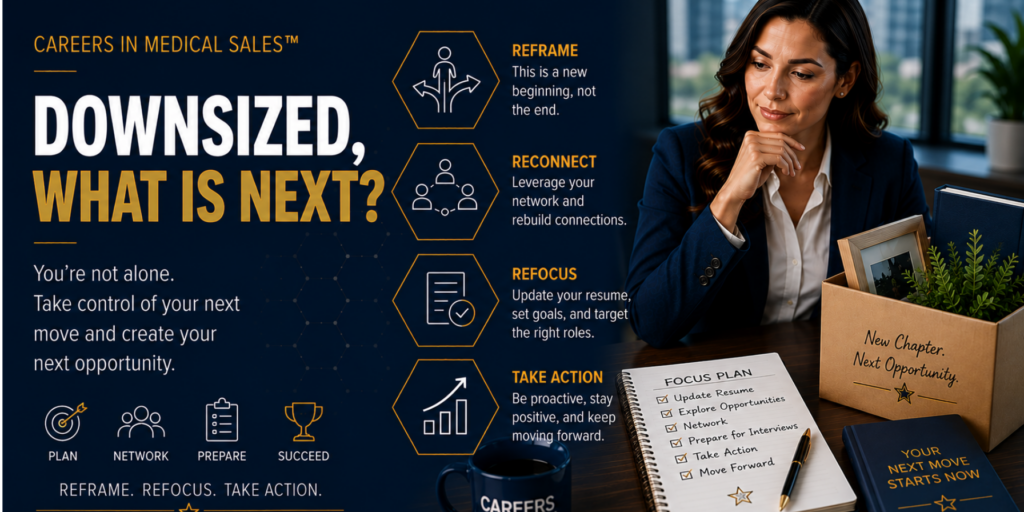
Career Transitions After a Layoff or Downsizing
Not every career transition is voluntary.
Medical and pharmaceutical sales organizations can go through mergers, acquisitions, territory realignments, restructurings, and reductions in force. A strong salesperson can lose a position even when the reason has nothing to do with individual performance.
If you have been downsized, don’t allow the event to redefine your professional value. Focus on your accomplishments, document your sales results, and begin evaluating your next opportunity.
Your previous performance still matters.
Keep a Record of Your Accomplishments
One of the best things you can do throughout your career is maintain your own record of achievements.
Keep track of quota attainment, rankings, awards, promotions, revenue growth, new accounts, major wins, territory growth, and other measurable results.
This information becomes especially valuable when you’re changing jobs or industries because it gives you concrete evidence of what you’ve accomplished.
Don’t Let a Career Transition Erase Your Confidence
Changing industries can make even successful professionals question themselves.
Remember that you are not starting from zero. You’re taking your experience into a new environment.
Be honest about what you still need to learn, but be equally clear about what you already know how to do.
Confidence comes from understanding your value—not from pretending you have experience you don’t have.
The Global Edge Recruiting® Perspective
Global Edge Recruiting® has specialized in medical sales recruiting since 1997. Over the years, we’ve seen professionals make successful moves between pharmaceutical sales, medical device sales, clinical careers, healthcare, biotechnology, and other sales environments.
We’ve also seen that the strongest transitions are usually the ones where the candidate can clearly connect the dots.
What have you accomplished? What skills transfer? What customers do you understand? What products or specialties are familiar to you? What makes the new opportunity a logical next step?
Those are the questions that should guide your career transition.
A Career Transition Should Move You Forward
A career change should have a purpose.
Maybe you’re looking for greater responsibility. Maybe you want to move into healthcare. Maybe you want to use your clinical background in a commercial environment. Maybe you want to move from pharmaceutical sales into devices or from devices into a specialty that better matches your experience.
Whatever the reason, define what you’re trying to accomplish before you make the move.
The right transition doesn’t erase your previous experience. It builds on it.
Ready to Make Your Next Move?
If you’re considering a transition into medical sales, start by evaluating your experience honestly and identifying where it aligns with the opportunities you’re targeting.
Strengthen your resume. Build your network. Research companies. Learn the industry. Prepare your explanation for the transition. And be strategic about the positions you pursue.
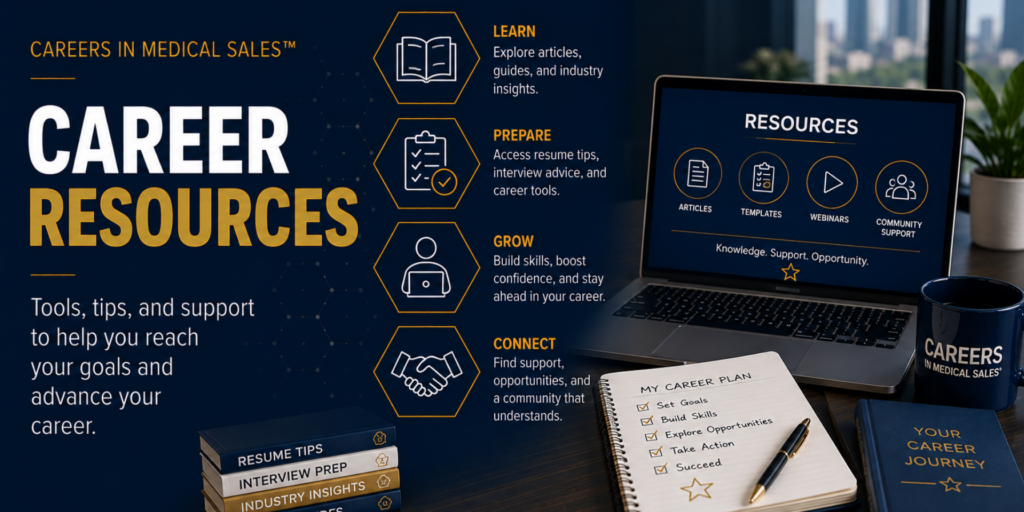
Careers in Medical Sales™ provides additional resources to help you with your job search, personal brand, networking, interviews, and working with medical sales recruiters.
When you’re ready, explore current Medical Sales Jobs or Submit Your Resume to Global Edge Recruiting® for consideration for current and future opportunities.
Career Transitions – Downsizing
Additional Career Resources in Medical Sales